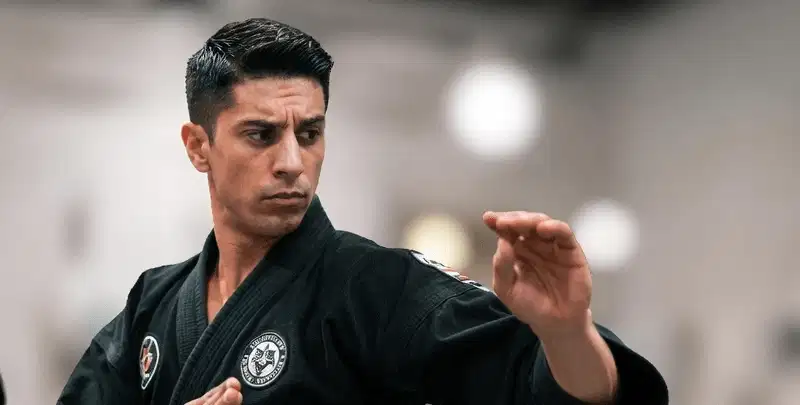
Kenpo Karate: History, Belt Order & Techniques

#Martial Arts #Karate #Kempo #Kenpo #Self Defense
Have you ever heard of Kenpo Karate?
What about Kempo? Same thing…?
Here’s the short answer: Yes. And no.
TL;DR
- Kenpo and Kempo are the same martial art—different spellings of the same Japanese characters (拳法)
- Origin: Chinese kung fu + Japanese karate, refined in America by Ed Parker
- Focus: Rapid combinations, practical self-defense, fluid movement
- Belt progression: White → Yellow → Orange → Purple → Blue → Green → Brown → Black (5-7+ years)
- Best for: Those wanting adaptable, street-practical techniques over sport competition
They’re the same martial art—just different spellings. The World Martial Arts Union recognizes Kenpo as a distinct style within the karate family, though its roots trace back further than most realize.
Kempo isn’t really Japanese. Not really Chinese either.
It’s both.
Kempo takes the flowing, circular movements of Chinese kung fu and blends them with the disciplined strikes of traditional karate. The result? A practical fighting system that’s been refined over centuries.
Now, whether you’re thinking about training, researching martial arts for your kids, or just trying to figure out what the heck Kempo is all about—stick with me.
I’m going to break it all down for you, to stick with me here. First up…
What is Kenpo Karate?
So what is Kenpo, exactly?
Kenpo martial arts (also written as Kenpō or Ken Po) combines Chinese kung fu techniques with Japanese karate principles. The name tells you everything: “Kempo” translates to “Fist Law” or “Fist Method.”
Now, I gotta tell you,
Unlike traditional karate—where you might hold a deep, rigid stance and throw one powerful punch—Kempo focuses on fluid, adaptive movements. You learn to flow from one technique to the next. No pausing. No resetting.
Think about it: In a real fight, does your opponent wait for you to get back into your perfect stance?
Nope.
And Kempo trains you for that reality.
Here’s what makes Kempo different:
- Rapid combinations - You’re not throwing one punch. You’re throwing five.
- Practical self-defense - Techniques that work on the street, not just in tournaments
- Fluid movement - Less rigid than traditional karate
- Complete toolkit - Strikes, kicks, blocks, joint locks, AND throws
- Mental discipline - The philosophy of continuous improvement
The truth is, Kempo teaches you to understand why techniques work—not just how to do them. And that deeper understanding arms you with the power to adapt when things don’t go according to plan.
Because in a real situation, they never do. As Mike Tyson said, “Everyone has a plan until they get punched in the face.”
The History of Kenpo Karate
Now, let me tell you a quick story about how Kempo came to be…
Kempo spans two continents and several centuries. And know this:
Chinese Origins
Is karate Chinese?
Partially. And Kempo? Even more so.
Kempo’s roots trace back to the Shaolin Temple in China. You’ve probably heard of it—monks developing fighting systems for self-defense and physical conditioning.
Check this out:
These techniques emphasized flowing movements, rapid strikes, and efficient body mechanics. Not the stiff, formal movements you might picture.
Chinese martial artists brought these methods to Okinawa (back when it was called the Ryukyu Kingdom). There, they merged with local fighting traditions.
And that Chinese Kenpo influence? It created the foundation for what would eventually become Kempo Karate.
Journey to Japan
When Okinawa came under Japanese control, these hybrid fighting arts spread to mainland Japan.
Japanese martial artists took the Chinese techniques and added their own flavor—incorporating elements from jujutsu and other Japanese systems.
The result was something unique: Chinese fighting principles with Japanese discipline and structure.
The American Evolution
Kempo underwent its biggest change in the United States. Ed Parker—often called the “Father of American Kenpo”—opened the first Kenpo school in the continental US in 1954.
But Parker didn’t just teach what he’d learned. He questioned everything. He analyzed techniques through physics and body mechanics. He asked, “Why does this work? And how can it work better?”. As a result of that, he created American Kenpo—a practical, street-oriented system that became hugely influential.
And get this: He trained the King himself, Elvis Presley, and choreographed Hollywood fight scenes. Not bad for a martial artist from Hawaii.
Other Kempo Styles
You should know about a few other styles too:
Shorinji Kempo is a Japanese martial art founded in 1947 that combines Zen Buddhism with self-defense. Different organization, different philosophy—but shares the “Kempo” name.
Hawaiian Kempo developed where Ed Parker first trained. Hawaii’s position as a cultural crossroads between East and West made it perfect for martial arts fusion.
Kenpo Jujutsu (also spelled Kempo Jujutsu) blends striking with grappling. Many modern Kempo schools incorporate these ground-fighting elements.
Kenpo vs Kempo: What’s the Difference?
OK, let’s clear this up once and for all.
You’ll see both spellings everywhere. Kempo. Kenpo. It drives beginners crazy.
Here’s the simple answer:
They’re the same thing.
Both are different romanizations of the same Japanese characters (拳法). The kenpo meaning is “Fist Law” or “Fist Method.”
That said, the spellings have come to represent slightly different traditions:
| Kempo | Kenpo |
|---|---|
| Often refers to Japanese/Okinawan styles | Often refers to American styles |
| More traditional approach | More modernized approach |
| Closer to original Chinese influences | Adapted for Western self-defense |
American Kenpo (with an ‘n’) specifically means Ed Parker’s system. Kempo (with an ‘m’) often means more traditional Japanese styles.
But honestly? Many schools use the terms interchangeably. Don’t get too hung up on the spelling.
Focus on finding a good school with quality instruction. That matters way more than whether they spell it with an ‘m’ or an ‘n’.
Is Kenpo Karate Effective?
This is the question everyone asks about any martial art.
And I’m going to give you a straight answer: Yes. Kempo is effective for self-defense.
But let me explain why—and also be honest about its limitations.
Why Kempo Works
Practical techniques: Here’s the thing—Kempo isn’t designed for tournaments. It’s designed for real situations. You train defenses against common attacks: grabs, punches, chokes. The stuff that actually happens.
Adaptability: Kempo teaches principles, not just memorized sequences. You learn to read situations and respond. That’s huge when something unexpected happens.
Comprehensive training: Strikes, kicks, blocks, joint locks, throws. You’re not helpless whether the fight stays standing or goes to the ground.
Realistic sparring: Most Kempo schools spar regularly. And that pressure testing? It develops timing, distance management, and the ability to actually perform when it matters.
The Honest Assessment
Now, I’m not going to pretend Kempo is magic. No martial art is perfect for every situation.
Your effectiveness depends on:
- Quality of instruction - A great teacher matters more than the style
- Training intensity - You get out what you put in
- Individual attributes - Size, athleticism, mindset all play roles
- The specific situation - No art prepares you for everything
For practical self-defense, Kempo’s emphasis on adaptability and real-world scenarios makes it solid. Just make sure you’re training somewhere reputable with qualified instructors.
Is Shaolin Kenpo Karate Legit?
I get this question a lot.
Shaolin Kempo Karate is a specific American style that combines Shaolin kung fu, karate, and jujutsu. Fred Villari developed it in the 1970s.
So is it legit?
Yes. It’s a legitimate martial art with established lineage, structured curriculum, and thousands of practitioners worldwide.
The system includes:
- Kempo combinations (numbered self-defense techniques)
- Shaolin-inspired forms and animal styles
- Grappling and ground defense from jujutsu
- Weapons training
What to Watch For
But here’s the thing—like any martial art with lots of schools, quality varies. A lot.
When you’re checking out a Shaolin Kempo school:
- Check instructor credentials - Can they trace their lineage? If they get defensive when you ask, that’s a red flag.
- Observe a class - Is there realistic training and sparring? Or just forms and compliant drills?
- Avoid “black belt factories” - Schools that promote quickly for money, not skill
- Ask about sparring - If they say their techniques are “too deadly to practice,” run.
With the right instructor, Shaolin Kempo can be excellent training. Just do your homework first.
Kenpo Karate Techniques
Let me walk you through what you’ll actually learn in Kempo.
It’s one of the more comprehensive martial arts systems out there. And that’s not marketing speak—it genuinely covers a lot of ground.
Striking Techniques
Kempo is famous for rapid-fire combinations. Not single strikes. Sequences.
- Punches: Jab, cross, uppercut, hammer fist, backfist
- Open-hand strikes: Palm heel, knife hand, ridge hand
- Elbow strikes: Horizontal, rising, downward
- Knee strikes: Front, circular, flying
The emphasis is on combinations—sequences of 3-5 techniques that overwhelm an opponent. You target vital areas and follow natural body mechanics.
Kicking Techniques
Kempo includes kicks. Truth be told,
It tends to favor low-to-mid-level kicks over high, flashy ones. Why? Because in a real fight, high kicks are risky. You can get swept. You can lose your balance. You can get caught.
- Front kick: Push kick and snap kick variations
- Side kick: For distance and power
- Round kick: Targeting legs, body, and head
- Back kick: Powerful reverse kick
- Sweep: Taking away an opponent’s base
Higher kicks are taught—but they’re emphasized less than in styles like Taekwondo.
Defensive Techniques
Defense in Kempo goes beyond just blocking:
- Blocks: Inward, outward, upward, downward
- Parries: Redirecting attacks rather than stopping them
- Evasion: Slipping, bobbing, footwork
- Checking: Controlling opponent’s limbs to prevent follow-ups
Grappling Techniques
Now, you might be thinking, “Wait—I thought Kempo was a striking art?”
It is, primarily. But it includes grappling elements too:
- Joint locks: Wrist, elbow, and shoulder manipulations
- Throws: Hip throws, leg reaps, sacrifice throws
- Takedowns: Practical methods to bring opponents down
- Ground defense: Escapes and reversals if you end up on your back
Kenpo Karate Katas and Forms
Katas (forms) are pre-arranged sequences of techniques you practice solo.
Some people think they’re outdated. “Why practice choreography when you could be sparring?”
Here’s why they matter:
Purpose of Katas
- Technique: Katas encode fighting knowledge passed down through generations
- Solo practice: Train without a partner
- Attribute development: Build balance, coordination, timing
- Moving meditation: Develop focus and mental discipline
Common Kempo Katas
Different lineages have different forms, but most share these categories:
Basic Forms:
- Pinan (Heian) series - Five foundational katas
- Short Form 1, 2, 3 - American Kenpo basics
Intermediate Forms:
- Long Form 1, 2, 3 - Extended technique sequences
- Animal forms - Tiger, Crane, Leopard, Snake, Dragon
Advanced Forms:
- Weapons katas - Bo staff, nunchaku, sai
- Two-person forms - Practiced with a partner
Training Tips
When practicing katas:
- Start slow - Get the technique right before adding speed
- Understand applications - Know what each movement is actually for
- Practice both sides - Don’t neglect your weak side
- Visualize opponents - Imagine real attackers, not empty air
Kenpo Karate Belt Order and Ranking System
The belt system tracks your progress from beginner to advanced. If you’re familiar with traditional karate belt order, you’ll notice some similarities—but Kempo has its own variations.
Now, exact colors vary between schools. But most follow a similar progression.
Standard Kempo Belt Order
| Belt | Level | Typical Timeframe |
|---|---|---|
| White | Beginner | Starting point |
| Yellow | Novice | 3-6 months |
| Orange | Intermediate beginner | 6-12 months |
| Purple | Intermediate | 1-2 years |
| Blue | Advanced intermediate | 2-3 years |
| Green | Advanced | 3-4 years |
| Brown (3rd, 2nd, 1st) | Pre-black belt | 4-6 years |
| Black (1st Dan+) | Expert | 5-7+ years |
These timeframes vary based on school, training frequency, and individual progress.
What Each Belt Represents
White Belt: You’re a blank slate. Open to learning. No bad habits yet.
Colored Belts: Progressive understanding of fundamentals. Each level adds new techniques while refining what you already know.
Brown Belt: This is serious student territory. Brown belts often help teach and demonstrate advanced proficiency.
Black Belt: Here’s what most people get wrong—black belt isn’t the end. It’s actually the beginning of real learning. First-degree black belt means you’ve got solid fundamentals and you’re ready for advanced study.
Beyond Black Belt
Many people view black belt as the ultimate goal. But in Kempo, it’s considered just the start.
Higher dan rankings take years—sometimes decades:
- 1st-3rd Dan: Technical mastery development
- 4th-6th Dan: Teaching and leadership roles
- 7th Dan+: Lifetime achievement, major contributions to the art
Kenpo vs Karate: Understanding the Differences
“Kempo” and “Karate” get confused all the time. But they’re actually different traditions with distinct characteristics.
Let me break it down:
Origins
Karate originated in Okinawa and was later systematized in Japan. It draws primarily from indigenous Okinawan fighting methods combined with Chinese influences.
Kempo represents a more direct transmission of Chinese martial arts principles, with Japanese adaptations. It maintains closer ties to kung fu concepts.
Movement Style
| Aspect | Kempo | Traditional Karate |
|---|---|---|
| Movement | Fluid, circular | Linear, direct |
| Stances | Mobile, transitional | Rooted, stable |
| Combinations | Long sequences | Single powerful techniques |
| Rhythm | Flowing, continuous | Stop-and-go |
Which Should You Choose?
Neither is “better.” They’re different tools for different preferences.
Some people thrive in Kempo’s adaptive, free-flowing environment. Others prefer traditional karate’s structured discipline.
Think about what you’re looking for. Then visit some schools and see what resonates.
Ryu Kyu Kenpo: The Okinawan Connection
Ryu Kyu Kempo deserves special mention. It’s the bridge between Chinese and Japanese martial arts.
What is Ryu Kyu Kempo?
It refers to martial arts from the Ryukyu Islands (modern-day Okinawa). These systems preserve older fighting methods from before karate was systematized for mass instruction.
Key Characteristics
- Pressure point attacks (kyusho): Targeting vulnerable areas
- Tuite: Grappling and joint manipulation
- Less sport-oriented: Focus on practical application
- Traditional weapons: Bo, sai, tonfa, nunchaku
Why It Matters
Ryu Kyu Kempo represents martial arts before they were modified for sport competition. Practitioners argue these systems preserve more combat-effective techniques that were later removed or softened.
Chinese Kenpo: Tracing the Roots
To really understand Kempo, you need to know its Chinese origins.
The Shaolin Connection
Chinese Kempo traces back to the Shaolin Temple, where Buddhist monks developed fighting systems over centuries.
Their methods emphasized:
- Efficient movement: Using body mechanics, not just strength
- Animal-inspired techniques: Tiger, crane, snake, leopard, dragon
- Internal development: Breathing, meditation, chi cultivation
- Weapon proficiency: Staff, sword, spear
Transmission to Japan
Chinese martial arts reached Japan through multiple routes:
- Trade contacts: Merchants and travelers sharing knowledge
- Military exchange: Samurai encountering Chinese fighters
- Okinawa: The Ryukyu Kingdom as an intermediate point
- Immigration: Chinese martial artists settling in Japan
Each transmission adapted the arts to Japanese culture and fighting needs. And eventually, it produced the various Kempo systems we see today.
Ed Parker and American Kenpo
Now let’s talk about a man you’re probably familiar with: Ed Parker.
The man basically brought Kenpo to the Western world. And he didn’t just teach it—he revolutionized it.
Parker’s Background
Edmund Kealoha Parker (1931-1990) was born in Hawaii. He started with Judo before discovering Kenpo under William Chow. In 1954, he moved to the mainland US and opened his first school.
Innovations in American Kenpo
Here’s what set Parker apart:
Systematized curriculum: He created a logical progression from white to black belt. Specific techniques, forms, and concepts at each level.
Motion-based system: Rather than rigid techniques, Parker taught principles of motion that could adapt to any situation.
Street-practical focus: Techniques designed for real attacks—grabs, punches, multiple attackers—not tournament scenarios.
The International Kenpo Karate Association: Parker founded IKKA to standardize instruction and certify instructors worldwide.
Legacy
Ed Parker’s students have become influential teachers themselves, spreading American Kenpo across the globe. His approach—analyzing traditional arts through modern understanding—influenced martial arts far beyond just Kenpo.
Choosing a Kenpo School
So you’re interested in training. Good.
But here’s the thing—finding the right school matters more than the specific Kempo style.
What to Look For
Qualified instruction: Can instructors demonstrate their lineage and credentials? If they can’t answer that question, move on.
Realistic training: Do classes include sparring and pressure testing? Or just forms and compliant drills?
Positive environment: The culture should emphasize learning and mutual respect. Not ego or intimidation.
Clear curriculum: You should understand what you’re learning and how you’ll progress.
Reasonable costs: Be wary of long contracts, excessive testing fees, or pressure to buy equipment.
Red Flags
- Instructors who can’t or won’t discuss their background
- No sparring or “too deadly to practice”
- Guaranteed black belts in unrealistic timeframes
- Excessive focus on selling rather than teaching
- Negative, ego-driven atmosphere
Try Before You Commit
Most schools offer trial classes. Take advantage of this.
Experience the teaching style. Meet current students. Assess the training intensity. See if it feels right.
Because you’re going to spend a lot of time there. Make sure it’s somewhere you actually want to be.
Conclusion
Look, here’s the bottom line:
Kempo Karate offers a unique blend of Chinese fluidity and Japanese discipline. It’s practical, adaptable, and designed for real-world self-defense.
Whether you’re drawn to traditional Kempo, American Kenpo, or one of the many derivative styles—you’ll find a rich tradition of martial knowledge.
But remember: The style matters less than the effort you put in and the guidance you receive.
Key takeaways:
- Kempo combines Chinese and Japanese martial arts traditions
- Kempo and Kenpo are different spellings of the same thing
- The art emphasizes practical self-defense and adaptability
- Belt progression takes years of dedicated training
- Quality of instruction matters more than specific style
Whatever path you choose, the journey through Kempo Karate offers physical fitness, mental discipline, and practical skills that last a lifetime.
And that’s worth the investment.
Run a karate or Kempo school? MartialArts.io helps you manage students, track belt promotions, and handle attendance—so you can focus on what you actually love: teaching.
© 2025 MartialArts.io. All rights reserved.